The AI Gap in the Workplace
The gap nobody put in the job description
For years, the big technology divide was simple to describe. Some people had a computer and a fast connection, and some did not. That gap is real and it is still not closed.
There is now a second gap on top of it, and it shows up inside the office. Two colleagues can sit at the same kind of desk with the same internet and get very different results, because one of them has learned to work with AI and the other has not. I have been on both sides of that conversation, and this post is about it.
Prefer to watch? Jump to the video.
A personal topic
This is a personal topic for me. I was one of the first to begin using AI in my workplace, and I knew how difficult it was to convince people to use the new tools.
My topic does not address the digital divide, which we already know. I view it as a new "AI Gap" affecting our workplaces, particularly in conservative cultures regarding, Artificial Intelligence.
Old divide, new divide
The old digital divide was about access. The AI gap is about skill, confidence and permission. A modern AI tool costs little or nothing to try, so the barrier is rarely the hardware. It is knowing how to ask, how to check the answer, and whether your workplace lets you try at all.
It also compounds. Someone who learns to write a good prompt, review the output and fold the result into daily work gets faster every month. Someone who waits falls a little further behind each time the tools improve.
The numbers around this are worth a look. The 2024 Work Trend Index from Microsoft and LinkedIn surveyed 31,000 people in 31 countries. It found that 75% of knowledge workers already use AI at work, and that 78% of those users bring their own AI tools instead of waiting for the company to provide them. Only 39% of AI users said they had received AI training from their company (Microsoft & LinkedIn, 2024). The World Economic Forum's Future of Jobs Report 2025 points the same way: employers named the skills gap as the biggest barrier to transformation, at 63%, and expect 39% of workers' core skills to change by 2030 (World Economic Forum, 2025).
Motivation
Just a few years ago, during the pandemic, some of our managers, thought the rise of AI was a signal that the world was going to end, and I cannot blame them for their religious and cautious approach. I am in a conservative country, Saudi Arabia, and still, some of the people are behind in adapting to new technologies and new norms.
But making this video, made me feel happy, allowing me to share my message. It is a message I have wanted to share a long time.
I just wish I could have convinced my colleagues earlier to invest in AI tools as part of our continuous learning in our IT team.
Caution is not the enemy
I want to be fair to the cautious people. Their worries are not silly. AI can be wrong, it can leak private data if used carelessly, and it raises hard questions about work and ownership. A team that says "slow down" is often protecting something real.
The answer, I think, is not to push harder. It is to make trying safe: clear rules about what data may be shared, a small pilot, and time to learn. Fear shrinks when people can see the tool working on something ordinary.
My core advocacy
This brings me to the core advocacy of my video:
"We must learn to harness the power of AI, but to do so responsibly, always use our own experience and wisdom to guide its power."
The video: Miguel and Kyle
Is AI a threat to our jobs, or a tool for our greatest advantage? The real question is no longer if we'll use AI, but how we'll keep up with the massive new skill-based digital divide it's creating.
In the video, I share my personal perspective as a software developer and tell the animated story of two professionals: Miguel, the seasoned expert, and Kyle, the AI-powered innovator. Their story reveals the challenges and, more importantly, the solution to this new divide at work.
I also take viewers behind the scenes to show how the video itself was created, using a partnership between human expertise (in Adobe Premiere Pro) and a suite of AI tools (like Google VEO, Gemini, and Epidemic Sound), to prove that the future is about collaboration.
The animated story, start to finish. It is my demonstration of how AI and experience work together. Watch on YouTube.
The story, scene by scene
The video opens with a question: to use or not to use AI at work? It then drops the question and asks a harder one. How do we keep up? A new digital divide is here, and it is no longer only about who has internet access. AI has redefined it. The video points to studies from leading firms, Microsoft among them, which suggest that professionals using AI tools are working significantly faster.
- Miguel is the expert who trusts skills and experience. He has an MIS degree and over 10 years in software technology.
- Kyle is the innovator who uses AI. He has five years in the same field and is known for quick, creative output.
- Their manager values one thing above all: results.
A client needs a redesigned login portal and a user dashboard, with three days on the clock. Miguel takes the dashboard. Kyle takes authentication. Kyle finishes first. He has built the login and registration forms, including multi-factor authentication and other security features, and the manager praises him for it. Miguel keeps working, convinced that the foundation and the integration have to be perfect.
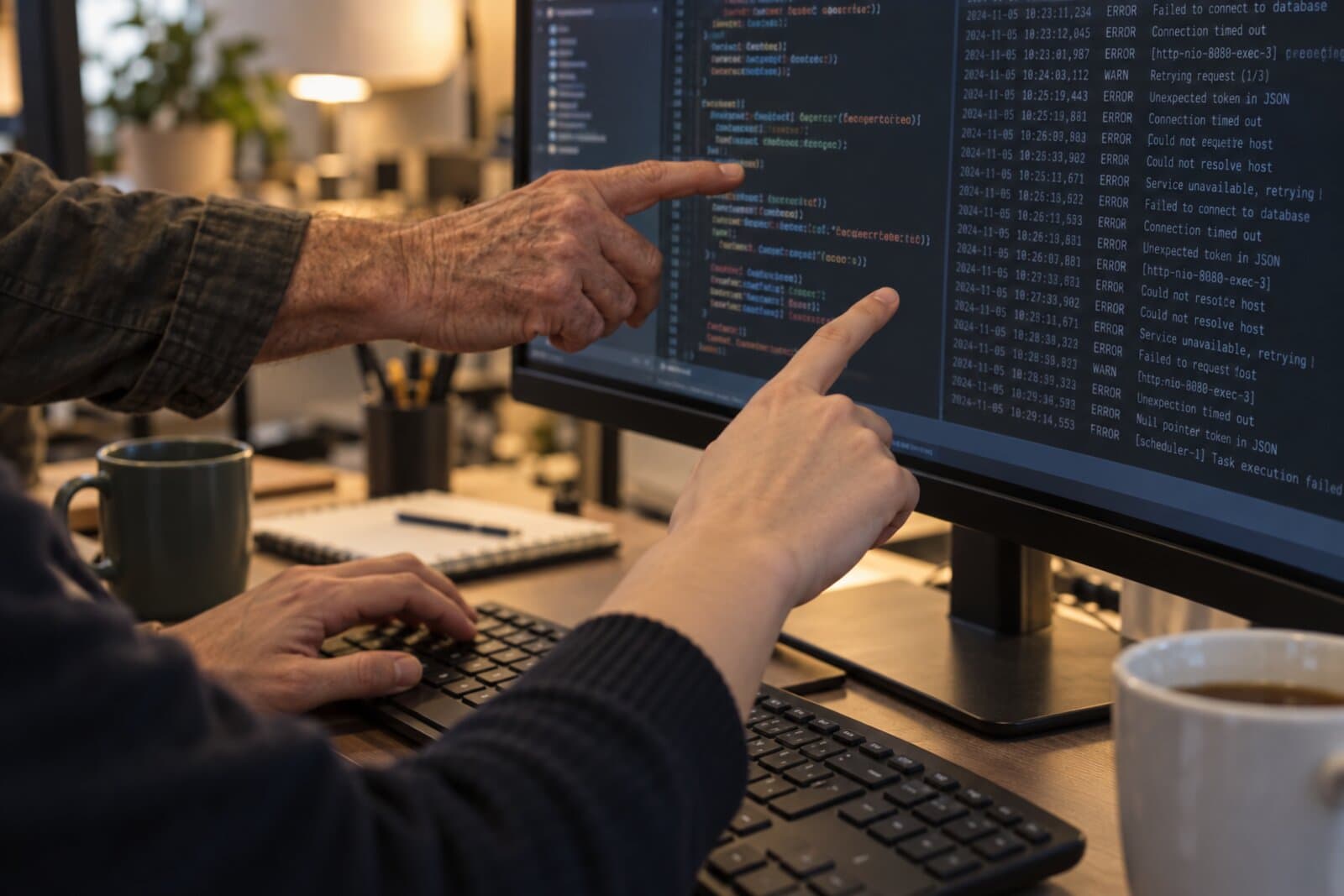
Then comes the crisis. The whole system goes down with a critical bug, and it is a problem the AI has never seen before. Kyle gives the tool every error log and asks it to analyze the architecture. It keeps returning generic answers, because it does not have the specific history of the system.
Miguel does. He remembers that about seven years earlier the team built a temporary workaround for a client's integration. It was a custom module that was never supposed to be permanent, and it was not in any documentation. The new update was conflicting with it. Miguel's experience pointed Kyle's speed at the real problem, and together they found a solid fix. Kyle sums it up: his AI tools could not have found that one detail, and all the experience in the world does not move that fast. The manager's reward is dinner. The two of them agree that they make a good team.
What the story is really about
Here is the engineer's reading of that scene. An AI model works with what is in its training and what you put in the prompt. Kyle pasted in logs and architecture, and that was all it had. The reason the system broke was a seven year old workaround that existed in one person's memory. No amount of prompting could have recovered it, because the information was never written down.
That is the quiet lesson. Documentation, institutional memory and plain experience are not obsolete in the age of AI. They are the context that makes AI answers specific instead of generic. A tool is only as good as the context you can give it, and sometimes the only place that context lives is a colleague who has been around long enough.
The reverse is true too. Miguel's knowledge found the cause, but the fix landed in three days because Kyle could move fast. Experience without speed is slow, and speed without experience is blind.

My reflection: I was both Kyle and Miguel
The story is personal because in my career I have had to be both. I felt the fear of being left behind, and the pull to rely only on my own skills. I have also seen the incredible power of the new AI tools. The two feelings do not cancel each other out, and I think a lot of people at work are living between them right now.
The biggest single lesson of this whole journey is simple. AI gives us the biggest advantage if we use it as a tool, and not if we let it make the decisions for us.
The video itself is my proof, and I will be honest about it. It took me a long time to write the scripts, because the AI could not finalize the story the way I wanted. It could draft and suggest, but the meaning had to come from me. That is why I came in with Adobe Premiere Pro to guide the process and to give the video a clear human sense. The speed was real, but it did not remove the work of deciding what the story was for.
How the video was made
The script and the shot list were drafted by Google Gemini. The characters and their voices were generated through Google Labs and Google AI Studio. The music and sound effects came from Epidemic Sound. Everything was put together in Adobe Premiere Pro.
- Google Gemini: content idea brainstorming for scripting, and shot list generation.
- Google AI Labs (Whisk): graphics generation and character consistency.
- Google AI Studio: character voiceover generation.
- Adobe Premiere Pro: video editor and subtitle generator.
- Epidemic Sound: background music and sound effects.
The pipeline, written as code
I think in pipelines, so here is how the video moved from idea to export. It is simplified, but the order is accurate, and the last two lines are the ones that matter most.
const pipeline = [
  { step: "Idea and script",    tool: "Google Gemini",          output: "draft script + shot list" },
  { step: "Graphics",           tool: "Google AI Labs (Whisk)", output: "consistent characters" },
  { step: "Voiceover",          tool: "Google AI Studio",       output: "character voices" },
  { step: "Music and sound",    tool: "Epidemic Sound",         output: "score + effects" },
  { step: "Edit and subtitles", tool: "Adobe Premiere Pro",     output: "final cut" },
];

// What no tool in the list did for me:
const myJob = ["finish the story", "decide what it means", "check that it is true"];
My advocacy
Our journey of constant adaptation is not about choosing between Miguel the expert and Kyle the innovator. Harness the power and speed of AI, but always guide it with your human wisdom. That is how we bridge the divide, and we should start it from ourselves.
What I would try first at work
If you are a Kyle who wants to bring a Miguel along, or a Miguel who is curious, here is where I would start:
- Pick one boring, repeatable task and try AI on that alone.
- Agree on what data must never be pasted into a tool.
- Share what worked and what failed in the team chat, not just the wins.
- Pair people up. The expert supplies judgment, the learner supplies speed.
- Always have a human review anything that leaves the building.
Closing thoughts
The point of the story is not that Kyle wins and Miguel loses. Miguel's experience is what makes AI useful and safe, and Kyle's speed is what makes experience go further. The gap closes when they learn from each other.
This is a conversation we all need to have. What are you seeing in your workplace? Do you feel more like a Miguel or a Kyle? Share your experience in the comments of the video.
References
- Microsoft & LinkedIn. (2024). 2024 Work Trend Index annual report: AI at work is here. Now comes the hard part. https://www.microsoft.com/en-us/worklab/work-trend-index/ai-at-work-is-here-now-comes-the-hard-part
- World Economic Forum. (2025). The future of jobs report 2025. https://www.weforum.org/publications/the-future-of-jobs-report-2025/
Enjoyed this? Get new posts by email
One short email when I publish something new. No spam, and you can reply to unsubscribe.